Danny Wang

School of EECS · The University of Queensland

Danny Wang

CS PhD candidate


I am a PhD student at The University of Queensland, Australia, specialising in large language models, diffusion language models, and graph machine learning. My research is supervised by Dr Ruihong Qiu, A/Prof Guangdong Bai, and Prof Zi (Helen) Huang. I completed dual Bachelor of Computer Science and Master of Data Science degrees at UQ under the supervision of A/Prof Tong (Rocky) Chen, graduating as the class of 2023 Valedictorian.

Most of my work circles one question: when a model is confident, how do we know it should be?

Curriculum Vitae

Research Interests

01

Large Language Models

Reliability and reasoning behaviour of LLMs — how models commit to answers, and how confidence and context shape what they get right.

02

Diffusion Language Models

Decoding strategies for discrete diffusion models — block commitment, training–inference mismatch, and parallel generation that stays coherent.

03

Graph Machine Learning

Out-of-distribution detection on graphs and text-rich networks — separating genuine signal from the spurious structure models learn to lean on.

Publications

01

VTrace framework figure

Preprint

* denotes equal contribution with random ordering

Tracing the Evidence: Faithful Token Attribution Through Vision-Language Reasoning

Bowen Yuan*, Danny Wang*, Ruihong Qiu, Zijian Wang, Zi Huang

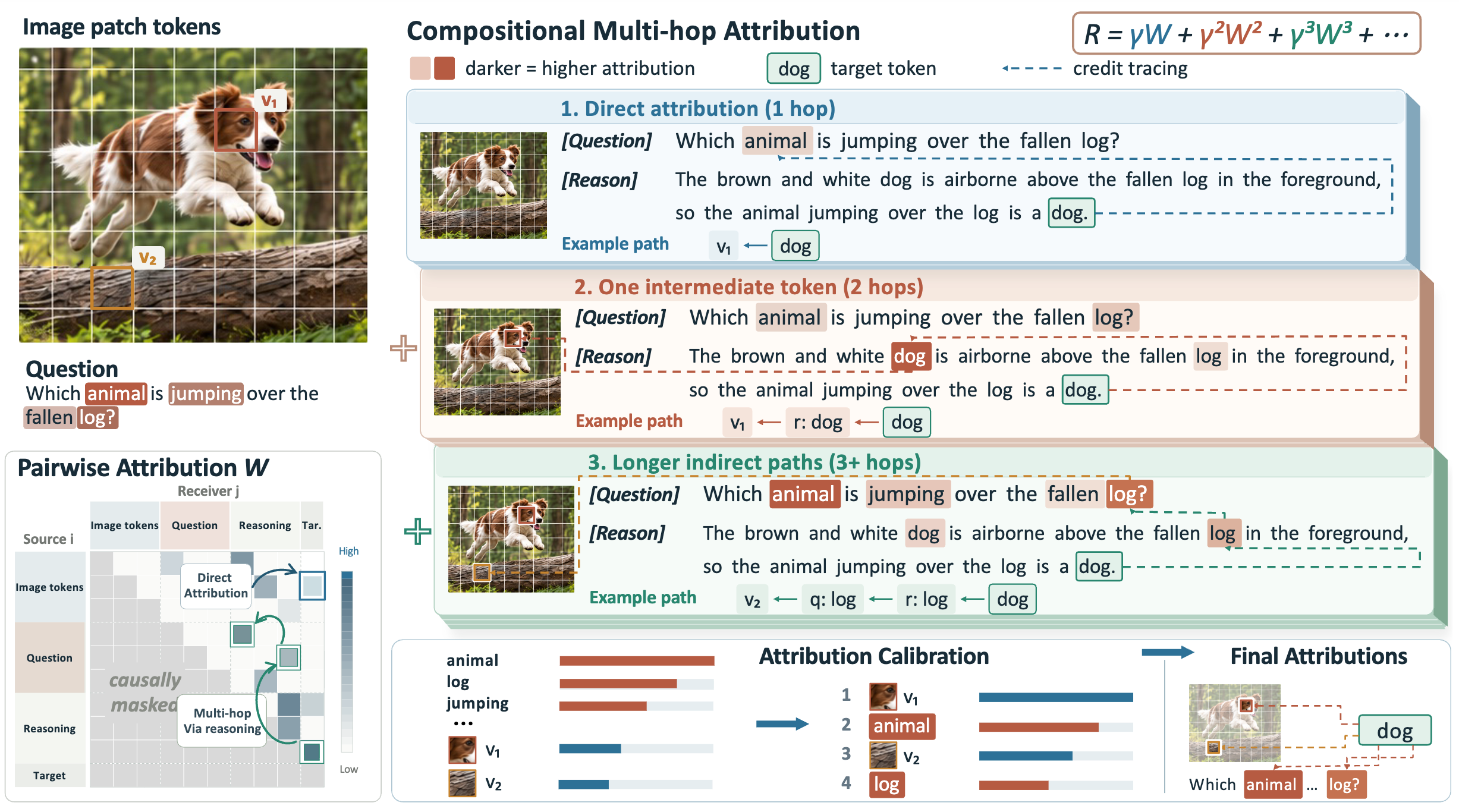
We propose VTrace, a token-attribution framework for vision-language models that traces how image and text tokens support a response through intermediate reasoning, and balances their scores across modalities.

+Abstract

Large vision-language models (LVLMs) exhibit strong reasoning capabilities, yet the visual and textual evidence supporting the generated responses remains difficult to identify. Faithful token attribution explains an LVLM's response by assigning scores that rank image and prompt tokens by how much the model relies on them, such that removing higher-ranked tokens causes the likelihood of the generated response to drop more rapidly. However, existing token-attribution methods have been developed mainly for text-based language models, and our empirical study reveals two challenges when complex multimodal sources are involved. First, the joint image-text attribution can underrepresent visual evidence relative to text, obscuring the image regions supporting the response. Second, visual evidence may influence the generated response through multiple intermediate reasoning paths, while existing methods trace only a limited subset of these paths, causing important visual contributions to be underestimated. Motivated by these insights, we introduce VTrace, a multimodal token-attribution framework that traces input contributions through intermediate reasoning and calibrates attribution scores across modalities. VTrace constructs pairwise attributions that highlight token-specific contributions and aggregates all forward attribution paths in closed form to account for both direct and indirect contributions. Cross-modal calibration then rescales image and text attribution scores using modality contributions estimated from response-likelihood changes, enabling a unified ranking of input tokens. Evaluations against seven baselines across six visual reasoning benchmarks demonstrate the superior attribution faithfulness.
02

Tide framework figure

ICML 2026

What Information Matters? Graph Out-of-Distribution Detection via Tri-Component Information Decomposition

Danny Wang, Ruihong Qiu, Zi Huang

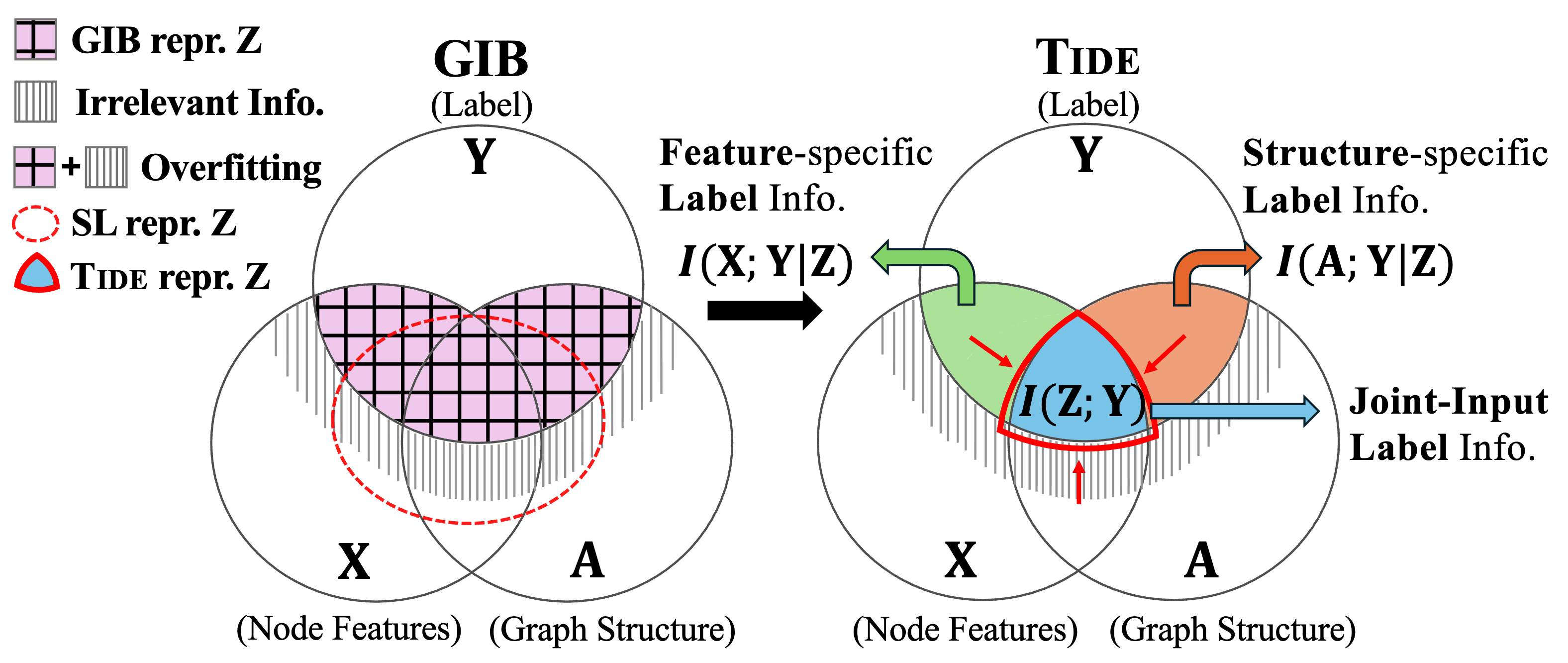
We propose Tide, a tri-component information decomposition framework for graph OOD detection that preserves shift-indicative, label-relevant joint signals.

+Abstract

Graph neural networks are widely used for node classification, but they remain vulnerable to out-of-distribution (OOD) shifts in node features and graph structure. Prior work established that methods trained with standard supervised learning (SL) objectives tend to capture spurious signals from either features and/or structure, leaving the model fragile under distributional changes. To address this, we propose Tide, a novel and effective Tri-Component Information Decomposition framework that explicitly decomposes information into feature-specific, structure-specific, and joint components. Tide aims to preserve only the label-relevant part of the joint information while filtering out spurious feature- and structure-specific information, thereby enhancing the separation between in-distribution (ID) and OOD nodes. Beyond the framework, we provide theoretical and empirical analyses showing that an information bottleneck objective is preferable to standard SL for graph OOD detection, with higher ID confidence and a greater entropy gap between ID and OOD data. Extensive experiments across seven datasets confirm the efficacy of Tide, achieving up to a 34% improvement in FPR95 over strong baselines while maintaining competitive ID accuracy.

Paper Code

03

VSB block decoding figure

Preprint

When to Commit? Towards Variable-Size Self-Contained Blocks for Discrete Diffusion Language Models

Danny Wang, Ruihong Qiu, Zi Huang

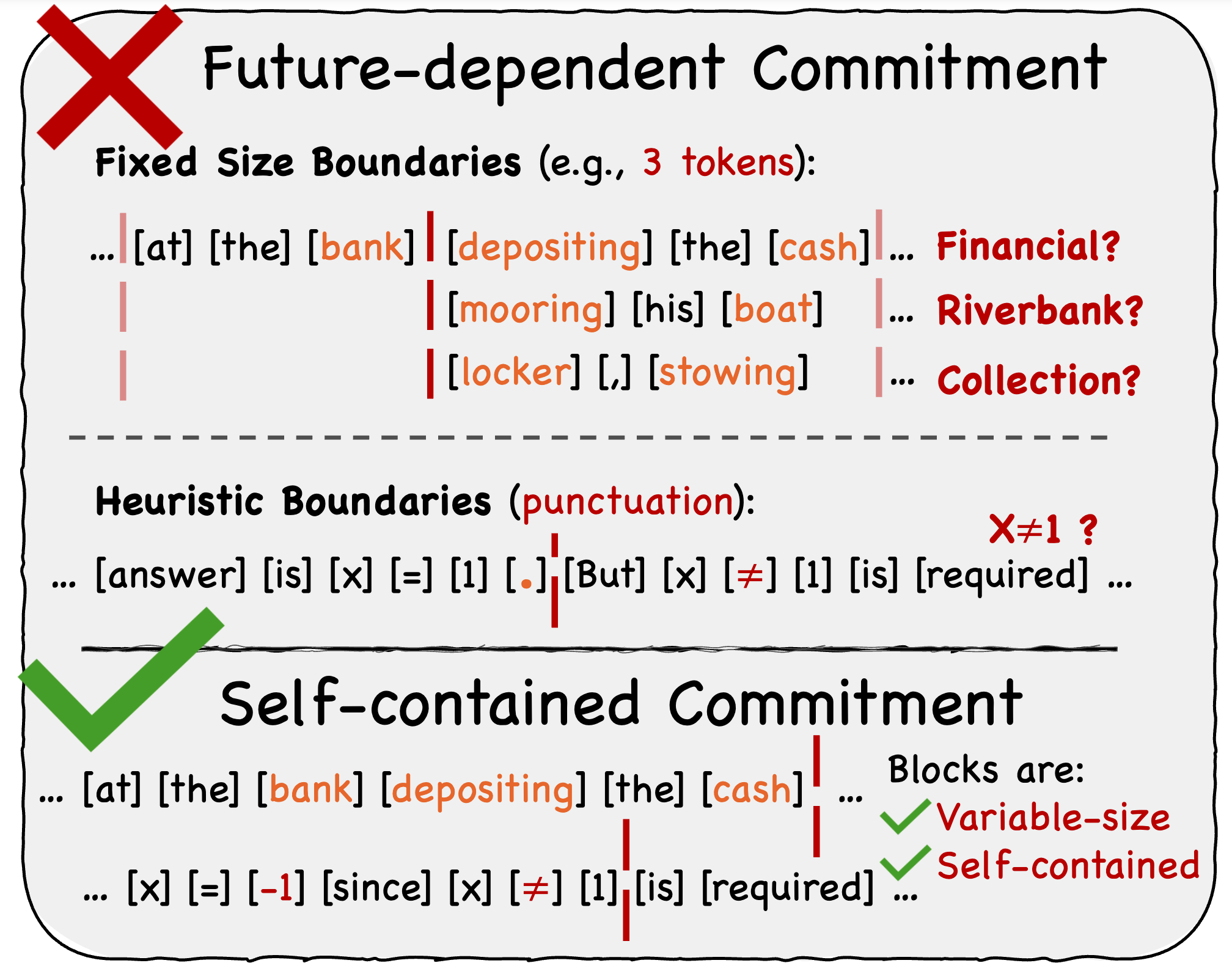
We propose VSB, a variable-size block decoding method for dLLMs built on a self-containedness principle, addressing future-dependent token commitment and training–inference mismatch.

+Abstract

Discrete diffusion language models (dLLMs) enable parallel token updates with bidirectional attention, yet practical generation typically adopts blockwise semi-autoregressive decoding. This switch creates a training-inference mismatch: training denoises with full-sequence context, while inference commits tokens within a bounded block without future context. Therefore, decoding with fixed-size or heuristic-based blocks can lead to premature token commitments, as decisions are made without full access to future context that could alter those choices. Motivated by this, we propose self-containedness as a principled criterion for block commitment. A block is self-contained if its predictions remain consistent with Future-Aware (FA) or without No-Future (NF) access to future context, reframing block boundary selection as a test of self-containedness rather than a heuristic choice. Based on this principle, we introduce Variable-size Self-contained Blocks (VSB) for dLLMs. VSB scores and selects block boundaries using the divergence between token-level predictive distributions under NF and FA conditioning, which quantifies how predictions would change if future context were revealed. We provide theoretical justification linking self-containedness to predictive consistency, and extensive experiments validate VSB's efficacy over fixed-size and heuristic blockwise decoding.

Paper

04

TNT-OOD figure

EMNLP 2025 · Main Track

Text Meets Topology: Rethinking Out-of-Distribution Detection in Text-Rich Networks

Danny Wang, Ruihong Qiu, Guangdong Bai, Zi Huang

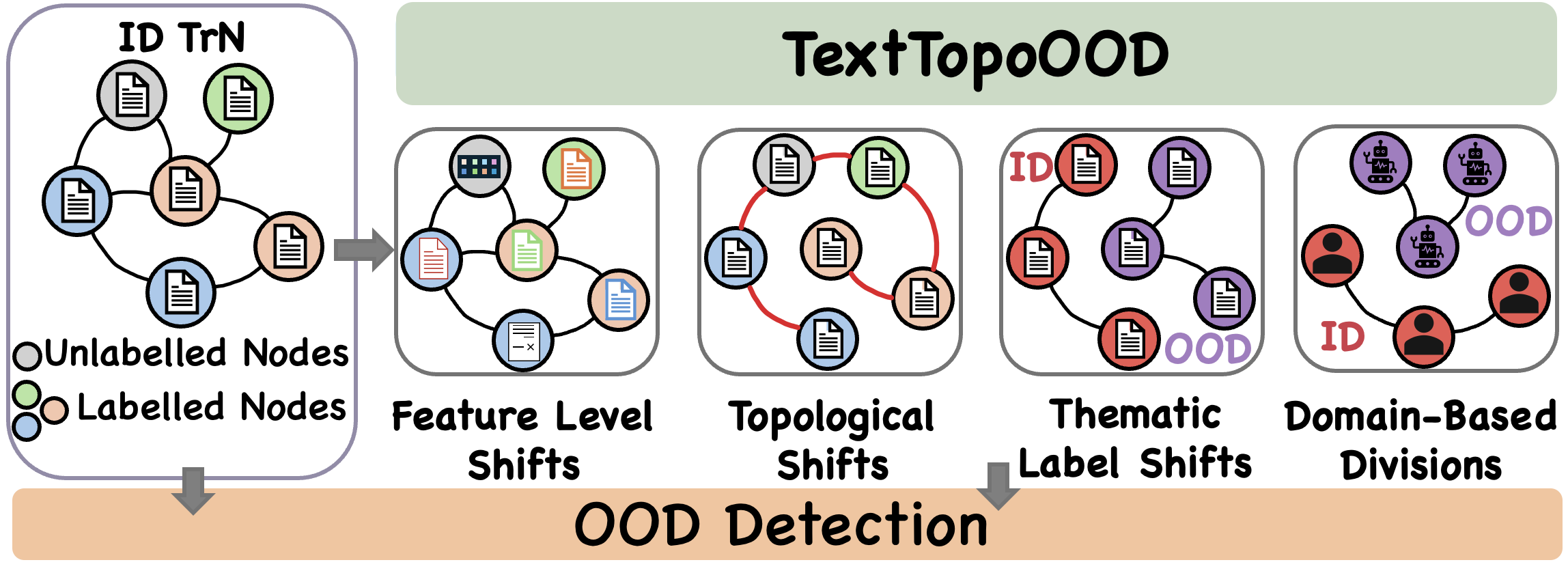
We introduce TextTopoOOD, a framework for modelling diverse OOD scenarios on text-rich networks, and TNT-OOD, a detection method that captures the interplay between text and topology.

+Abstract

Out-of-distribution (OOD) detection remains challenging in text-rich networks, where textual features intertwine with topological structures. Existing methods primarily address label shifts or rudimentary domain-based splits, overlooking the intricate textual-structural diversity. For example, in social networks, where users represent nodes with textual features (name, bio) while edges indicate friendship status, OOD may stem from the distinct language patterns between bot and normal users. To address this gap, we introduce the TextTopoOOD framework for evaluating detection across diverse OOD scenarios: (1) attribute-level shifts via text augmentations and embedding perturbations; (2) structural shifts through edge rewiring and semantic connections; (3) thematically-guided label shifts; and (4) domain-based divisions. Furthermore, we propose TNT-OOD to model the complex interplay between Text aNd Topology using: 1) a novel cross-attention module to fuse local structure into node-level text representations, and 2) a HyperNetwork to generate node-specific transformation parameters. This aligns topological and semantic features of ID nodes, enhancing ID/OOD distinction across structural and textual shifts. Experiments on 11 datasets across four OOD scenarios demonstrate the nuanced challenge of TextTopoOOD for evaluating OOD detection in text-rich networks.

Paper Code

05

GOLD framework figure

ICLR 2025 · Spotlight

GOLD: Graph Out-of-Distribution Detection via Implicit Adversarial Latent Generation

Danny Wang, Ruihong Qiu, Guangdong Bai, Zi Huang

We propose GOLD, an implicit adversarial learning pipeline for graph OOD detection with synthetic OOD exposure and no pre-trained generative models.

+Abstract

Despite graph neural networks' (GNNs) great success in modelling graph-structured data, out-of-distribution (OOD) test instances still pose a great challenge for current GNNs. One of the most effective techniques to detect OOD nodes is to expose the detector model with an additional OOD node-set, yet the extra OOD instances are often difficult to obtain in practice. Recent methods for image data address this problem using OOD data synthesis, typically relying on pre-trained generative models like Stable Diffusion. However, these approaches require vast amounts of additional data, as well as one-for-all pre-trained generative models, which are not available for graph data. Therefore, we propose the GOLD framework for graph OOD detection, an implicit adversarial learning pipeline with synthetic OOD exposure without pre-trained models. The implicit adversarial training process employs a novel alternating optimisation framework by training: (1) a latent generative model to regularly imitate the in-distribution (ID) embeddings from an evolving GNN, and (2) a GNN encoder and an OOD detector to accurately classify ID data while increasing the energy divergence between the ID embeddings and the generative model's synthetic embeddings. This novel approach implicitly transforms the synthetic embeddings into pseudo-OOD instances relative to the ID data, effectively simulating exposure to OOD scenarios without auxiliary data. Extensive OOD detection experiments are conducted on five benchmark graph datasets, verifying the superior performance of GOLD without using real OOD data compared with the state-of-the-art OOD exposure and non-exposure baselines.

Paper Code

06

GetFair framework figure

KDD 2024

Hate Speech Detection with Generalizable Target-Aware Fairness

Tong Chen, Danny Wang, Xurong Liang, Marten Risius, Gianluca Demartini, Hongzhi Yin

GetFair detects hate speech equitably across diverse target groups, including those unseen during training, by removing the classifier's spurious dependence on target-related features.

+Abstract

To counter the side effect brought by the proliferation of social media platforms, hate speech detection (HSD) plays a vital role in halting the dissemination of toxic online posts at an early stage. However, given the ubiquitous topical communities on social media, a trained HSD classifier can easily become biased towards specific targeted groups, where a high rate of either false positive or false negative results can significantly impair public trust in the fairness of content moderation mechanisms, and eventually harm the diversity of online society. Although existing fairness-aware HSD methods can smooth out some discrepancies across targeted groups, they are mostly specific to a narrow selection of targets that are assumed to be known and fixed. This inevitably prevents those methods from generalizing to real-world use cases where new targeted groups constantly emerge over time. To tackle the defects of existing HSD practices, we propose Generalizable target-aware Fairness (GetFair), a new method for fairly classifying each post that contains diverse and even unseen targets during inference. To remove the HSD classifier's spurious dependence on target-related features, GetFair trains a series of filter functions in an adversarial pipeline, so as to deceive the discriminator that recovers the targeted group from filtered post embeddings. To maintain scalability and generalizability, we innovatively parameterize all filter functions via a hypernetwork. Taking a target's pretrained word embedding as input, the hypernetwork generates the weights used by each target-specific filter on-the-fly without storing dedicated filter parameters. In addition, a novel semantic gap alignment scheme is imposed on the generation process, such that the produced filter function for an unseen target is rectified by its semantic affinity with existing targets used for training. Finally, experiments are conducted on two benchmark HSD datasets, showing advantageous performance of GetFair on out-of-sample targets among baselines.

Paper Code

Services, Teaching & Awards

Services

2026KDD, AAAI, ICLR, ARR May, ICML — Gold Reviewer, top 25%
2025ICLR, ICML, NeurIPS, ARR May, IJCAI, IEEE TSC
2024CIKM, IJCAI

Teaching

2026Head Tutor — Advanced Techniques for High Dimensional Data (INFS4205/7205)
2025–26Thesis TA — Research and Development Methods and Practice (REIT7842)
2024–25Tutor — Master of Data Science Capstone (DATA7901/7903)
2024–25Tutor — Advanced Techniques for High Dimensional Data (INFS4205/7205)
2022Tutor — Introduction to Data Science (DATA7001)

Education

2024–27Doctor of Philosophy in Computer Science, The University of Queensland
2020–23Bachelor of Computer Science / Master of Data Science, The University of Queensland — GPA rank 1st

Awards

2023Selected as class of 2023 Valedictorian for the graduation ceremony of the Faculty of Engineering, Architecture and Information Technology.
2020–23Dean's Commendation for Academic Excellence, Faculty of Engineering, Architecture and Information Technology — awarded for excellence in academic performance.

© 2026 Danny Wang

Updated August 2026

Visitors
Visitor map for dannyw618.github.io